Ride with enduro foams, but at what price? comparator Freenduro
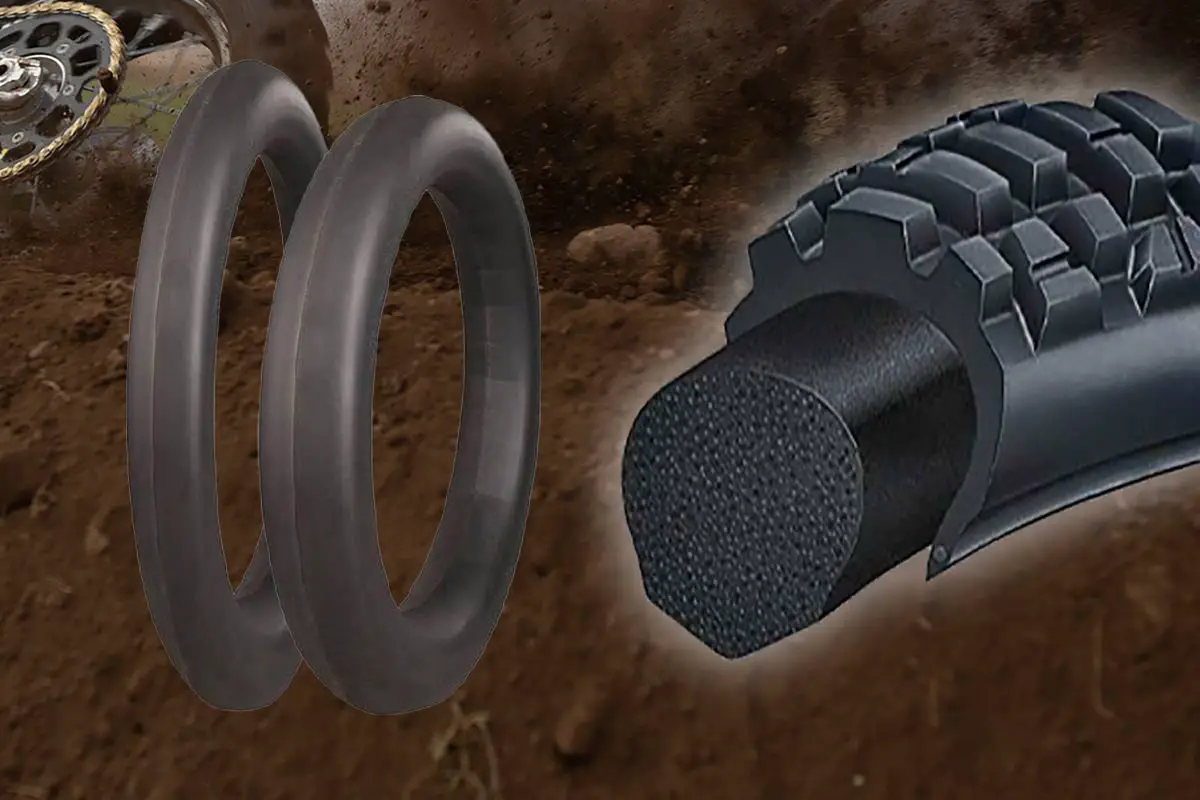
Invented and developed by Michelin in the 80s (1983/84) the Anti-Printing Foam (bib mousse) for the tyres of enduro motorcycles has long remained the preserve of the Clermont-Ferrand manufacturer. But even though Michelin remains the market leader in this segment, in recent years other brands have decided to enter this niche and are successfully developing enduro foams.

Purchase comparison for enduro foams: Bib mousse Michelin / Up / Mitas / Gibson
If this competition on enduro foams is rather beneficial for enduro enthusiasts, because it offers us a wider range of choices, this on the other hand failed to bring down enduro foam prices. In addition, after the covid crisis and today the soaring energy prices, the prices of these anti-screw foams are starting to rise again (like those of Enduro tyres).
We have therefore decided to create this price statement for enduro foams to allow you to compare. Here, it will not be a question of telling you what is the best brand on the market, or whether it is better to roll in foam or in a room (this is up to you, but below, we show you the advantages and disadvantages of foams) but simply to make a statement of the current rates.
Advantages and disadvantages of enduro foams
👍 The Benefits
- Really increvable
- No repair tools to carry
- Makes it possible to roll “stronger” in roots and stones.
- Excellent grip when the bib is well honed (after a few hours of driving)
- Immediate grip without running-in: Possibility to mount a new foam in 120 standard in an AR tire in 140 (ideal on soft or wet ground).
- Possibility of making holes in a bib to have an equivalent pressure less than 0.9 b when new.
- Some foams are now available as a “SOFT” reference for hard-enduro enthusiasts looking for a maximum grip.
👎 The Disadvantages
- High price (between 100 and 150 €)
- Non-adjustable pressure (equivalent to 0.9 bar when new, then gradually decreases)
- Heavier than a chamber, and the gyro effect makes the bike a little less manoeuvrable.
- Hard to get into the tire (requests some help)
- Limited lifespan (from 6 to 18 months max)
- Not approved for driving on open roads
- Manufacturers advise not to drive at more than 130 km/h
Standard, Soft, Extreme: What foam hardness to choose?
The foam market has evolved a lot. Foam is no longer chosen solely on the basis of the size of the tyre, but also on the basis of the type of steering:
- Standard foam (equivalent to 0.9 to 1.1 bar): Ideal for classic riding, fast hiking and cross-country riding. It offers excellent rim protection at high speed and longevity.
- Soft foam (equivalent to 0.7 to 0.8 bar): The perfect compromise for technical enduro and light crossing. The grip is immediate without the need to “rode” the foam for hours.
- Extreme / Super Soft foam (equivalent to 0.5 bar or less): Reserved exclusively for Hard Enduro / Extreme Crossing. It must be paired with two GRIPSTERS (tyre locks) to prevent the tyre from turning on the rim.
Enduro foam prices by brand
Michelin BIB MOUSSE – (enduro medium)
UP foam
Enduro moss Mitas
Enduro foam Technomousse
Enduro foam X-grip
The size matching trap: Watch out for the volume!
This is the most common mistake among endurists: buy a 140/80-18 foam for a 140/80-18 tire, thinking it will match every time. In reality, the internal volume varies enormously from one tyre brand to another.
Concrete example: A Michelin Enduro Medium 140 tyre is much larger than a Mitas or Metzeler tyre of the same size. If you fit a standard foam from another brand into a Michelin tyre, you may end up with a feeling of underinflated tyre (equivalent to 0.6 bar) from the first ride. Conversely, a new Michelin foam in a narrow tyre will be a hell to ride.
⁇ The Freenduro tip for immediate grip (without running-in)
If you want grip right away without going through the break-in (which takes several hours), there is an unstoppable technique: mount a new foam in standard size 120 (not soft) in a rear tire in 140. This ensures excellent deformation and maximum motor skills from the very first metres. Be careful, however, this trick is to be reserved as a priority for movable or wet land (mud, grass, sand) to preserve your rim.
Advice: Always refer to the foam manufacturer’s specific correlation table rather than the simple size on the sidewall of your tyre.
The crucial importance of mounting gel
To finish this overview, a little advice if you want to improve the longevity of your foams. When you mount your foams, imperatively and generously use mounting lubricating gel (spread also within the tire, avoiding the heel so that your tire does not turn on the rim). This will prevent your foams from heating up while driving, as the heat caused by friction is the number one cause of the premature destruction of enduro foams.
Take a look here if you want to make some savings on your mounting gel.
Frequently Asked Questions about Enduro Tire Foams (FAQ)
How long does a Bib Mousse last?
On average, a hard foam between 6 and 12 months for an amateur pilot driving regularly. Its lifespan depends on three factors: the frequency of relubrication (ideally every 2 to 3 tyres), the speed of rolling (fast lanes destroy foams by heating) and storage (the bike must be put on a central crutch so as not to crush the foam when stopped).
Can we reuse a tired foam?
Yes! A well-known trick for endurists is to recycle a tired rear foam (which has shrunk) by mounting it in a front tire, or by adding a piece of used air chamber (or a half-cut foam) to give it back volume: This is known as the top-up technique.
Why does my new foam look so hard at first?
This is perfectly normal. A foam needs a run-in period of 1-2 hours for its cells to relax and provide the optimal feeling of approximately 0.9 bar.
The history of Michelin foam bib
The foam bib is a foam insert that is placed inside the motorcycle tyre, replacing the inner tube. It is therefore intended to eliminate the possibility of puncture.
Developed in the 80s by the Michelin brand, to answer the problem of tire punctures of Dakar drivers, the foam bib was then introduced for the first time on the consumer market. It was first used in motocross competition in 1991 by American rider Jeff Stanton, who won the AMA 500cc championship that same year.
Since then, it has been used by many professional enduro riders (and sometimes also motocross riders) and has long been considered the best puncture-proof solution on the market. For this, the Michelin bib quickly became essential with endurists.
Over the years, and in the face of the gradual arrival of many quality competitors, the Clermontois manufacturer has continued to develop and improve its foam bibs using increasingly advanced materials and adding special features to meet the needs of different types of terrain and riding styles.
Video tutorials: installation of enduro foam
Here is an excellent tutorial with Benjamin Mélot to learn the right technique with classic tire dismantlers:
A second video tutorial, but this time for the assembly/disassembly of an enduro foam with a Rabaconda Tire Machine :
See also our comparison of enduro tyres
Bonus: The essential tools to properly mount your foams
If you are a fan of crossings and other hard-enduro, our purchase guide for special extreme enduro tyres You'll probably be interested.