Sacoche banane enduro 2026 : Top 7 des meilleurs modèles
To avoid unnecessarily burdening one’s shoulders and back on the motorcycle, the most rational off-road solution is to remove heavy equipment in a Enduro banana bag brought to the lumbars.
A well-thought-out ventral bag is infinitely more pleasant than a large backpack. By placing the tools, the spare candle or even a water supply on the basin, it lowers the centre of gravity du pilote, ne ballotte pas dans les passages cassants et supprime les douleurs cervicales en fin de journée. Pour rouler léger, deux écoles s’affrontent : combiner un petit sac d’hydratation dorsal avec une sacoche à outils (type Scott), ou opter pour une sacoche lombaire hybride grand volume intégrant directement une poche à eau (type USWE).
With more than twenty years of practice on the trails and in competition, we know perfectly well what first drops on an enduro bag: the mud-logged zippers (zips) and the seams of the ventral belt under the weight of the tools. This test bench evaluates the actual quality of the webs, the width of the lumbar support and the dynamic stability on the shocks to avoid buying a model that will end up ventilated after three exits.
Our 2026 express podium: the 3 best enduro bags
To make the right choice immediately according to your practice:
- 1. The absolute reference tooling: Scott Six Days — Irreproachable comfort, wide double-tight belt (solid Velcro + micrometric buckle) and specific folding flap with individual elastic brackets for each tool. It does not move a millimetre in the pierriers.
- 2. La meilleure sacoche hydratation/outils : USWE Zulo 6L — An ultra-wide NDM ergonomic belt that eliminates any rebound on the hips, 6 litres of useful volume and a 1.5 L insulated water pocket included for those who refuse to carry a backpack.
- 3. Best value for money: O’Neal Toolbag — une alternative robuste, dotée d’une vraie sangle lombaire large, de deux poches latérales zippées très accessibles et d’un textile 600D résistant pour un tarif très doux.


Technical comparison of the 7 best enduro 2026 banana bags
Click on the name of a model to go directly to its detailed test bench:
| Model | Maintenance & Belt | Volume | Main asset | Note Freenduro |
|---|---|---|---|---|
| 1 Scott Six Days | Double Wide Clamp (Top) | Generous (4.5 L) | Tool tray folding & stability | 5/5 🥇 |
| 2 USWE Zullo 6L | NDM Wide Belt (Zero Rebound) | 6 L + 1.5 L pocket | Built-in hydration & replaces the bag | 4,8/5 🥈 |
| 3 O’Neal Toolbag | Double velcro clamp + clip | Standard (4 L) | Best value for money | 4.5/5 🥉 |
| Acerbis Profile | Effective double clamping | Standard (3 L) | Sober and proven ergonomics | 4/5 |
| Hebo Race | Adjustable double strap | XXL (Large Capacity) | Maximum load volume for raids | 3,5/5 |
| Shot Climatic | Standard double clamping | Intermediate (3.6 L) | Floor-priced water-repellent canvas | 3,5/5 |
| Fox Deluxe Toolpack | Simple thin strap | Generous (3 pouches) | Look neat but lack of heavy support | 3/5 |
Detailed test bench: the 7 enduro bags screened
1. Scott Six Days bag: The absolute reference of closed parks


The Scott Six Days is undoubtedly the most successful model and the most popular with regular competitors and hikers. Its padded ventral belt in neoprene with double closure (inner Velcro wideband + outer clip buckle strap) completely locks the load on the pelvis. Even on receptions of violent jumps or passages of steps, the bag never jumps against the lumbars.
Its main opening reveals a folding tool tray equipped with individual elastics to hold each key without scrap noise. The two zipped side pockets make it possible to isolate small precious objects (fast fastener, candle, car keys) without opening the central compartment.
- We like: the unparalleled lumbar support, the tool compartment arranged to the millimetre, the strength of the seams and YKK zips.
- We regret: a slightly higher price than entry-level models, largely offset by its longevity.
2. Sacoche USWE Zulo 6L : combo hydratation & porte-outils, zéro rebond
The Swedish brand USWE applies its anti-ballottement know-how to the waist with the Zullo 6L. It is one of the few bags on the market capable of competing with the Scott on the holding width thanks to its curved ergonomic ventral belt equipped with the technology NDM (No Dancing Monkey). The bag is body with the lower back and absolutely does not bounce in whoops or high rises.
Weighing only 380 g empty, it offers a unique versatility: it comes with a 1.5L Compact Insulated Water Pocket equipped with a magnetic clip hose. For pilots who refuse to carry a backpack in special or high heat, this is the absolute weapon. And if you prefer to ride without water, the compartment releases a massive space of 6 liters with mesh organizers to carry a complete tooling, an air chamber and spare levers.
- We like: flawless maintenance without rebound and with double tightening (velcro and crip) , the water bag of 1.5 L included, the generous volume of 6 L and the feather weight of 380 g.
- We regret: a higher tariff positioning due to its technicality and its standard insulated water pocket.
[Bonus] Sacoche bannane USWE Waist 6 litres
Pour ceux qui utilisent déjà une poche à eau dans leur dos, USWE a pensé avec vous avec une sacoche bannette au tarif plus contenu mais sans poche à eau. Il s’agit du modèle UWE Waist de 6L , identique au modèle Zolu mais donc sans la poche à eau (ni tuyau) intégrée.

3. O’Neal Toolbag: The best quality/price ratio
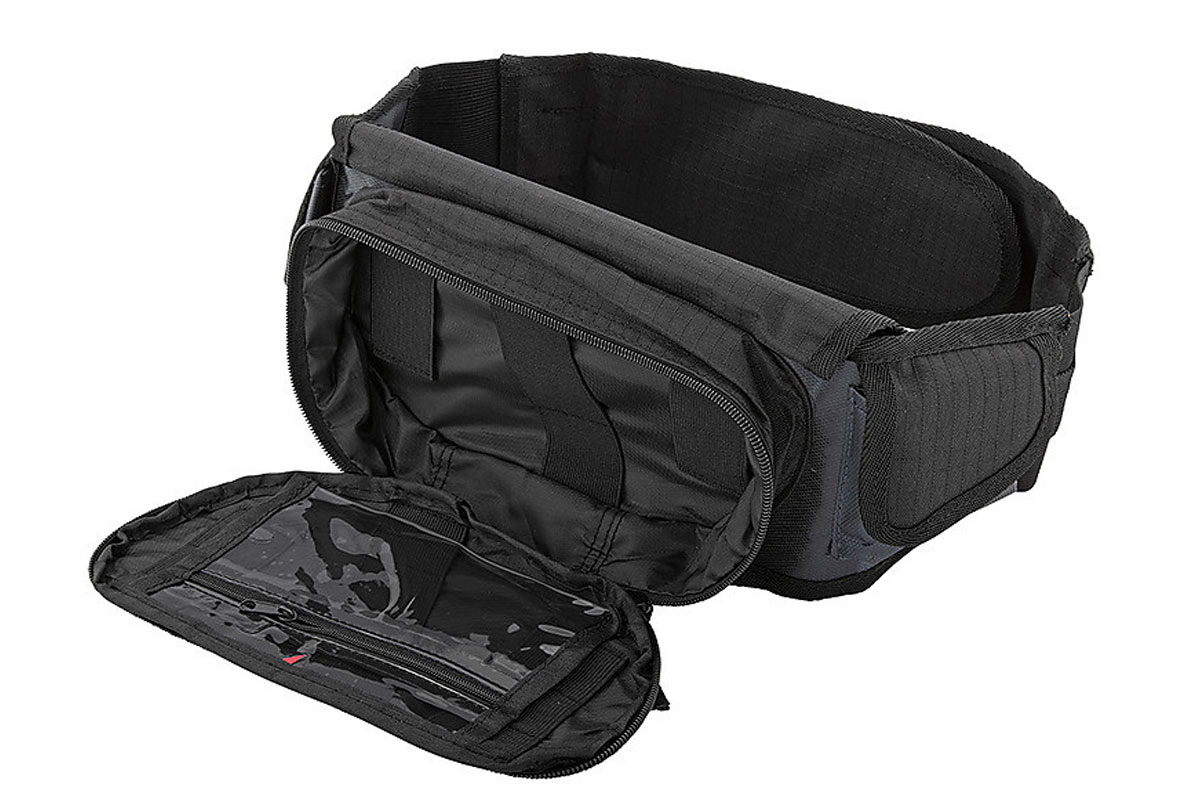


True to the Californian brand’s reputation for robustness,O’Neal Toolbag is the most rational choice for pilots looking for reliable equipment without exceeding €35-45. It takes up the fundamentals of a real enduro banana: a wide and comfortable belt with double clamping, avoiding any shearing at the waist.
With its watertight central compartment and two zipped pockets with direct access to the hips, it handles mud spraying and regular washing without weakening.
- We like: the general strength of the 600D textile, the wide belt well ventilated, the particularly aggressive tariff.
- We regret: an interior tool flap slightly less compartmentalised than on the Scott.
- for
- The price
- Ceinture large (bon maintien)
- Double fermeture ventrale ( velcro et boucle)
- Poches latérales zippées pratiques
- Pochetet ventrale zippée
- Grande pochette transparente à l'intérieur du rabat principal
- against
- Design un peu massif/classique
- Rangement interne moins optimisé que Scott ou la Fox
4. Acerbis Profile bag: The Italian Sure Value


Historical Rival of the Scott, theAcerbis Profile offers a proven formula for many seasons. It adopts a balanced format of about three litres of capacity, with a fold-out inner tray for attaching your screwdrivers, clamps and flat keys.
Its ventral support is effective thanks to its ventilated elastic band. The finishing of the seams and the thickness of the canvas are a notch below the Scott Six Days, but it remains an excellent sustainable option for weekend leisure outings.
- We like: well-thought-out general ergonomics, practical side storage, compactness on the hips.
- We regret: zips more sensitive to the accumulation of fine earth in very muddy conditions.


5. Hebo Race bag: The Queen of Large Volumes


The Spanish brand Hebo offers with the model Race the bag with the most generous volume of our comparison. It is the preferred ally of route openers, long-distance baroudeurs or drivers competing in regional rally-raids who need to carry much more than four flat keys (emergency air chamber, rolled windbreaker, snack and first-aid kit).
- We like: impressive loading capacity, strength of the main straps.
- We regret: an internal organization typed "catch-all" which requires to search to find its tools at the bottom of the bag.

6. Shot Climatic bag: The watertight first price option


Developed by French supplier Shot, the Climatic placing on a water-repellent coated fabric that effectively delays the infiltration of water and moisture into winter quagmires. With its intermediate volume of 3.6 litres, it offers a well-proportioned compromise to house the basic tooling without weighing on the kidneys.
- We like: floor price, good protection against external humidity, balanced intermediate volume.
- We regret: elastics to hold loose tools that deserve to be supplemented by a soft textile kit.


7. Fox Deluxe Toolpack: Style before heavy efficiency


The Fox Deluxe Toolpack seduces at first glance with its modern finishes and neat visual identity. Its multiple pockets and folding flap are well cut out. However, when tested against off-road racing, its architecture shows a major technical limit: its tightening belt is too narrow and does not offer a double wrap-around Velcro headband.
As soon as you load the bag with a full set of steel keys and a clamp, the weight rotates the bag down and it swings over the bumps. It is ideal for carrying a few light trinkets, but shows its limits as a real heavy tool bag.
- We like: the quality of visual presentation, well-compartmented pockets.
- We regret: insufficient maintenance of the single strap on heavy loads, tossing on high ground.

- for
- Panneau dos EVA moulé avec canal d’aération
- Rangement outils optimisé (dépliant)
- Look et finition Fox (Haut de gamme)
- 2 poches latérales zippées pour un accès rapide
- against
- Prix élevé (Le prix de la marque)
- Sangle ventrale trop fine
- Absence de double serrage ventral
Practical guide: What should you put in your enduro banana bag?
The goal of a good toolkit is not to redo a low engine in the middle of the woods, but to repair in ten minutes for never go back on foot. Here is the minimum list validated by our editorial team:
- The tools specific to your motorcycle: an articulated candle wrench (with a new candle protected in bubble wrap), the three or four flat/mixed wrenches corresponding to the nuts of your machine (usually 8, 10, 12 or 13 mm), a quality compact multi-socket clamp and a flat/cruciform reversible screwdriver for the carburettor or suspension settings.
- The quick-repair kit: a dozen solid Rilsan collars, a tube of two-component epoxy paste to seal an ignition housing pierced on a stone, a quick chain fastener adapted to your step (520), a metre of annealed wire and American tape (wrapped around a lighter to save space).
- Spare orders: a clutch lever and a front brake lever of origin (or adaptable), often broken net during a cant drop.
- Security and papers: your loaded smartphone (placed in a waterproof Zip freezer bag), a folded survival cover, a cereal bar and your insurance certificate.
Frequently Asked Questions (FAQs): Understand everything about banana bags
Banana bag or backpack: What is the best choice in enduro?
The golden rule is: combine the two equipments. Dense and heavy parts (steel tools, keys, levers) must be placed in the banana bag to maintain weight on the pelvis and lower the center of gravity. The backpack should remain as light as possible, dedicated only to water and an extra windbreaker. Conversely, if you use a hybrid bag such as theUSWE Zullo 6L, you can completely remove the backpack by housing both your tools and your 1.5L water pocket on the hips.
How to clean a bag full of mud without damaging the zips?
Never put your bag through the pressure washer (Kärcher) at the washing station! The powerful jet pushes the micro-silica grains inside the meshes of the zippers and destroys the water-repellent coating of the fabric. Let the mud dry, brush with a soft sweeper in a basin of warm water, and regularly apply a blow of silicone spray or wax on the slides to preserve their fluidity.
• Discover our selection of best hydration backpacks for enduro.
• Before you start, adjust your pressures with our pressure chart for enduro and cross tyres.