Duel Alpinestars Tech 3 vs Tech 7 boots: what are the differences and which one to choose for enduro or MX?
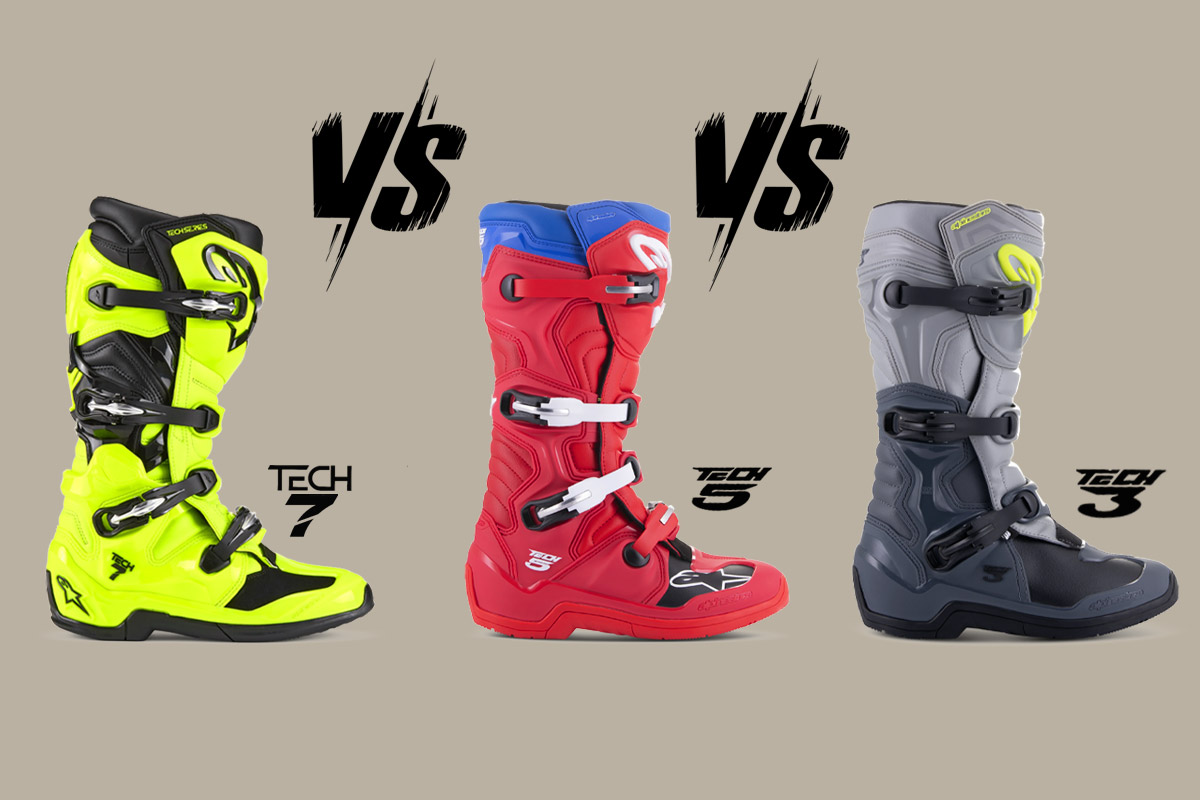
After comparing Tech 7 to Tech 10, let's look at the core of the Alpinestars range: the Trio Tech 3, Tech 5 and Tech 7. Is it necessary to spend more on a Tech 7, or is Tech 3 enough? At Freenduro, we dissect the insides of these boots to understand what you really pay: marketing or security?
To help you see more clearly, we have summarised the main part of our test below. Here is what you need to remember to identify in the blink of an eye which boot is made for your level and playground.”
The Freenduro Summary
- Tech 7 is the absolute reference: It is the only one of the trio to offer effective protection against violent shocks thanks to the Kevlar and the double pivot.
- Tech 5 is the comfort compromise: it has 4 buckles and a medial pivot, but remains a ‘soft’ boot with no real side-twisting lock.
- Tech 3 is an initiation boot: Ideal for a smooth start, but its simplified structure and synthetic materials quickly show their limits.
The prize match
Express comparison: Tech 3 vs Tech 5 vs Tech 7
| Characteristic | Tech 3 (Initiation) | Tech 5 (Leisure) | Tech 7 (Performance) |
|---|---|---|---|
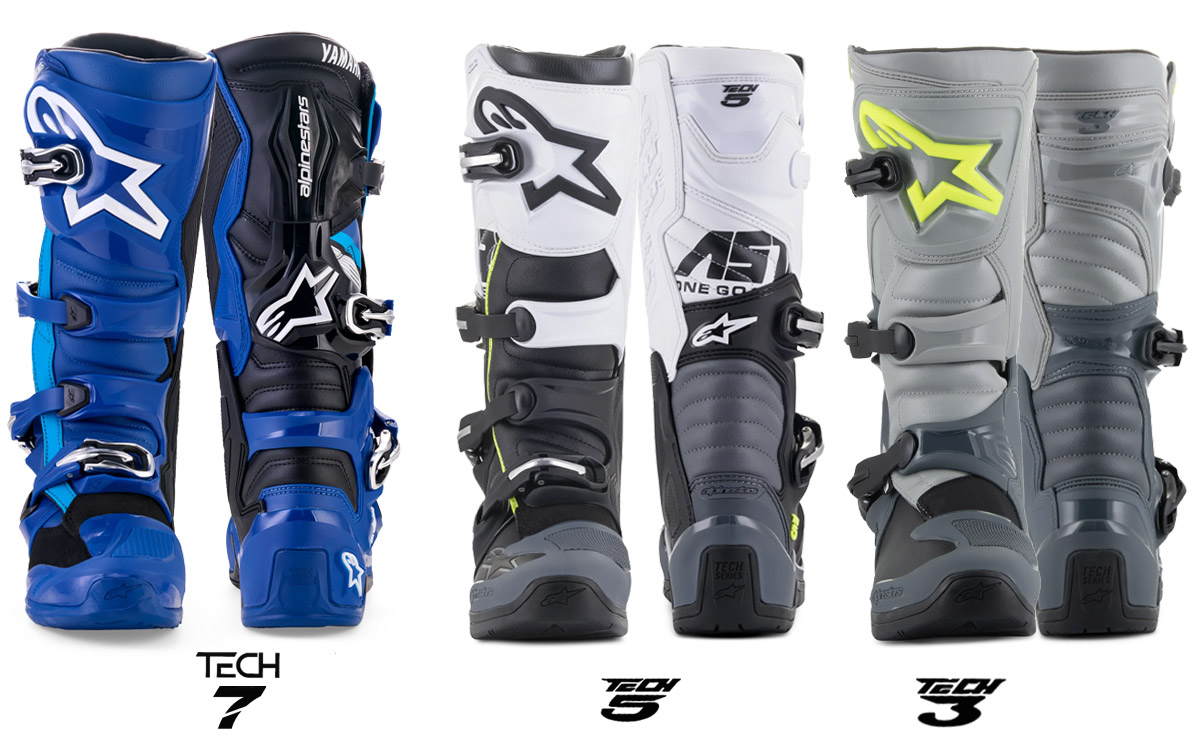
| Protection | Basic: medial biomechanical blade, simple bending. | Intermediate: medial biomechanical pivot, structural support | Expert: real double pivot, layer of Kevlar®, extra-hard compounds. |
| Comfort | Anatomical cut, but rigid synthetic materials | Extended accordion areas, superior comfort | “relax” fit, immediate comfort, soft suede upper. |
| Closure | 3 plastic buckles | 4 aluminium/plastic buckles | 4 aluminium buckles |
| Weight (per boot) | The lightest (~1.54 kg) because simplified. | ~1.60 kg (excellent weight/price ratio). | ~1.65 kg (upper dynamic balance). |
| Materials | Synthetic microfiber and PU (risk of peeling). | Microfiber and synthetic polymer. | Daim (Suede), microfiber and high density TPU. |
| EC standard | EN 13634:2010. (old standard) | CE certified. | EN 13634:2017 (current standard). |
Important 🚀: Tech 7 has evolved!
Since the end of 2025, Tech 7 has benefited from a major update: lighter, stronger and even more efficient. It is this model, with the red wear indicator and the Kevlar reinforcement, that should be preferred today.
1. Protection and structure: the danger of entry-level
Let us be clear: Tech 3 is an initiation boot. Its TPU structure is less enveloping on the top of the foot, leaving flexible areas exposed to frontal shocks. It uses a “bio-mechanical blade” that allows walking, but offers no stops against lateral torsion of the ankle. It is not recommended in motocross (MX) engaged.
The Tech 5 progresses with a medial pivot connecting the lower and upper parts, providing welcome structural support for hiking. But only Tech 7 (2026) offers a survival cell: a layer of Kevlar® surrounds the structure under the sole to maintain the integrity of the boot during extreme impacts. Its double pivot (median and lateral) literally locks the ankle against dangerous rotations.
The technical corner: What is TPU?
The TPU (thermoplastic polyurethane) is the king material in the manufacture of modern protective boots. It is an elastomer that combines the elastic properties of rubber with the rigidity of technical plastics.
- Impact resistance: it absorbs and dissipates energy from shocks without breaking.
- Abrasion resistance: it withstands repeated rubbing against the frame or floor.
- Flexibility: Unlike standard plastic, it does not become brittle with the cold and retains the flexibility necessary for movement.
In the Alpinestars range, the higher the range (from Tech 3 to Tech 7), the denser and "extra-hard" the TPU used on critical areas for increased security.
2. Ageing: Why do Techs 3 and 5 “pillow”?
This is the major defect of Tech 3 and Tech 5 observed by the pilots: at the joint folds and the top of the scaly foot. The technical explanation is given in the construction sheets:
- The Tech 7 uses a suede upper (turned leather) with a lightweight microfiber structure. The suede supports thousands of repeated folds without cracking.
- Tech 3 and 5 are based on microfiber and an extended synthetic PU gaiter. This plastic subjected to sludge and water ends up drying and ‘pelling’ after only a few months of intensive use.
3. Weight: the balance paradox
On the scale, the Tech 3 wins the match (~1.54 kg) because it is technically "empty" (no heavy pivot, 3 loops). The Tech 5 sits just above (~1.60 kg), offering an innovative microfiber chassis that is extremely durable while remaining lightweight for its class. However, the Tech 7 (~1.65 kg) is often considered more "light" in dynamics thanks to its fluid articulation and its refined toe area (since 2025) that facilitate steering.

4. Water and sludge management
Tech 3 has an extended synthetic PU gaiter to block water. Tech 5, thanks to its microfiber upper, already offers very high levels of water resistance and durability, while remaining easy to clean. Tech 7 goes further with a soft gaiter specifically designed for the rear and a heat-resistant TPU medial panel. Attention: the suede of the T7 requires a natural drying to remain flexible.
5. The variations
- Enduro (T3 & T7): Exclusive Alpinestars notched soles for porting (hard enduro type) or greasy floors.
- Drystar (T7): for those who drive all year round in the rain, but beware of the reduced breathability of these Drystar models.
- Stella (T3): cut suitable for female calves.
 Declinefrom €215.96 at FC-Moto.FR
Simulator: which boot according to your motorcycle practice?
| Your profile | Favourite land | The Freenduro Choice |
|---|---|---|
| Beginner / Tight budget | Flat paths, initiation | Tech 3 |
| Regular hiker | Paths, wood | Tech 5 |
| Endurist / MX driver | Pierriers, jumps, ruts | Tech 7 |
| Looks for max longevity | Intensive use | Tech 7 |
9. Maintenance: How to save your investment?
- Washing: soft brush and warm water. Never pass the Kärcher inside the boots.
- Wear witness: on Tech 7, monitor the red indicator on the sole. As soon as it appears, change the central insert!
- Suede care: brush the suede part of the T7 once dry to give it back its grip and flexibility.
What is the major difference between Tech 3 and Tech 7?
The Tech 7 has a Real Double Pivot (median and lateral) and reinforcement Kevlar® under the sole for maximum protection. Conversely, the Tech 3 is an initiation boot using a system of ‘blades’ that is much less rigid in the face of twists.
Is the Tech 3 enough for motocross?
No, no. It is sorely lacking in lateral support to absorb the receptions of jumps and violent shocks in bends. It is reserved for initiation or leisurely hiking.
Why are my boots peeling at the folds?
This is the premature ageing of the PU Synthetic used on Tech 3 and 5. The Tech 7 avoids this problem by using a suede rod (true leather), much more resistant to repeated flexions.
Which of the Tech 7, Tech 5 or Tech 3 is the most resistant?
The Tech 7 is undoubtedly the most robust. She is the only one who meets the standard EN 13634:2017 (compared to 2010 for the T3) and has a TPU shell with extra-hard compounds on the impact zones that better protects against violent shocks and moreover the Tech 7 resists better over time (it does not swallow).
Is Tech 5 a good compromise?
Yes, because it wins a 4ᵉ loop and a medial pivot compared to the T3. However, it does not have the Kevlar® structure or the double pivot of the T7, which limits it to regular hiking use rather than extreme enduro or MX.
Best prices of the moment TECH 3 / 5 / 7






Comments
Leave a comment