Purchasing guide: What motor hoof for enduro and hard-enduro?

If there is essential protection as soon as you leave the concession bike, it is the engine hoof. In enduro, a split crankcase in the middle of the woods means the end of the output, a salty bill with sometimes an HS engine.
Long dominated by aluminium, the market has undergone a real revolution: Plastic has taken power. Lighter (at least 30 % lighter than aluminium), more slippery and less noisy (less resonance with the engine), it is now available in several forms and materials. Thickness, level of protection, manufacturing system, management of tie rods … Here is everything you need to know to make the right choice, followed by the screening of the main brands on the market.
1. The battle of materials: Polypropylene VS HDPE
Forget aluminum hooves, place for a few years to “plastic” hooves. But behind the generic name “plastic” are different technologies that dictate the strength, stiffness and price of the hoof.
Polypropylene (classic injected plastic)
- Thickness: on average 3 to 4 mm.
- Manufacture: the plastic is melted and then injected into a mould. This allows for more complex, highly fluid shapes that perfectly fit the curves of the motorcycle’s frame and engine.
- Behaviour: very light and flexible. It effectively protects against stone splashes and light impacts.
HDPE/Nylon (high density and reinforced versions)
- Thickness: usually from 6 to 8 mm.
- Manufacture: cut/thermoformed or injected with composites (such as nylon enriched with metal inserts). It is the strongest for enduro.
- Behaviour: it has no brittle rigidity; it absorbs the energy of the shock and allows the motorcycle to drag on obstacles (trunks, steps, rocks) instead of sticking to them.
2. Manufacture: “welding VS folding”
To make a thick HDPE clog with side guards, two methods compete. Each has its own small weak point that sharp pilots need to be aware of:
- The welded hoof (e.g.: AXP, X-Grip): the different parts (the underside and the side ears) are cut separately and then hot-welded.
The weak point: Welding is a line of structural weakness. On a very large side impact, welds can eventually crack or give way.
- The clog folded in one piece (e.g.: Meca System): the plate is heated and then folded to form the hoof, without any welding.
The weak point: the plastic has a “shape memory”. Over time, repeated shocks and especially the intense heat released by the engine, the lateral fins tend to deform and “wipe” (deviate from the engine) over time.
3. Shape and wrapping: how far should we protect?
A good hoof should not just protect the bottom of the frame. The devil hides in the details and the side cover surface:
- Thin clogs (Cross type): they protect only the frame tubes and the central crankcase. They offer the advantage of less mud storage, but leave the sides bare, so they are not recommended for enduro.
- The classic enveloping hooves: they rise very high on the sides to encompass the water pump and the ignition and clutch housings (such as the AXP Xtrem range).
- Targeted cover hooves: they favour finesse and mainly protect the underside of the housings and the water pump, but extend their moulding backwards to wrap the housings. foothold brackets (like the Acerbis Factory model). This prevents the foot rest axes from twisting or blocking with mud and stones.
4. Is there a need for integrated rod protection?
This is the great geometric debate of modern enduro. Motorcycles equipped with rod suspensions (Husqvarna, GasGas, Beta, Sherco, Yamaha…) have their mechanism very exposed, located under the swing arm.
- The long clog (with extension of rod): it is extended backwards by a rigid tab covering the rods. Necessary for crossing so as not to destroy its bearings or remain “tanked” on a log.
- The KTM exception (PDS system): on enduro KTMs, the shock absorber is attached directly to the oscillating arm via the PDS ballhead. No biellette, so no need for a long hoof! A short hoof is more than enough. This avoids adding weight to the bike and carrying kilos of mud unnecessarily to the rear of the engine.
5. The test bench: the 8 must-have brands
Here is a summary of the strengths and weaknesses of the main players in the plastics market to help you decide.
Sabots AXP Racing – The French reference in HDPE 6 or 8 mm

The tricolor brand, specialist in all-terrain motorcycle protection, is a world reference in the design and manufacture of HDPE motor hoofs and offers two very distinct ranges according to your practice:
- Material / Thickness: HDPE / 8 mm (enduro Xtrem range) or 6 mm (enduro/MX/Sable range).
- Manufacture: mechanically cut flat and assembled by waterproof thermal welding.
- Coverage: total and enveloping, rising very high above the water pump and ignition.
- Biellette: thermoformed XL ski extension automatically integrated on the Xtrem version.
User feedback: field returns confirm that the 8 mm Xtrem version is a real tank. Its ability to absorb large vertical impacts without transmitting vibrations in the footrests is unanimously welcomed. Hard Enduro drivers appreciate its perfect glide on wet trunks. On the other hand, its very enveloping shape tends to trap heavy mud if specific clog foam is not used, and access to the drain screw sometimes remains narrow over certain vintages.

⁇ Also read: Find our complete test of the AXP Xtrem Enduro PHD clog
Acerbis Sabot – The choice of the official KTM team in Hard Enduro

- Material / Composition: 6mm High Performance Injected Composite (80 % nylon, 20 % aluminium for structural inserts). Careful exterior finish with a Carbon Imitation Texture (alleged factory look, but it is not real carbon).
- Manufacture: High pressure injection moulding with direct integration of alloy anchoring plates.
- Protection: targeted and ultra-adjusted. Protects the underside of the engine block, the water pump and, where it differs from the competition, it is that this Acerbis clog innovates by encompassing the front and bottom of the foothold brackets. The high side housings remain uncovered.
- Biellette: sold short, but incorporates pre-drilling designed to add the brand's universal bib protection for bib motorcycles.
User feedback: chosen by the Red Bull KTM Factory team for the 300 EXC by Manuel Lettenbichler, this clog seduces with its different profile and very close to the mechanical elements (carters). Users love the fact that he marries the bike like a second skin, drastically reducing the shovel effect. The protection of the wedges axes is considered great in ruts and rocks. The downside of regeling users: the reinforced nylon is very rigid but wears out by abrasion faster than a large block of HDPE of 8 mm.

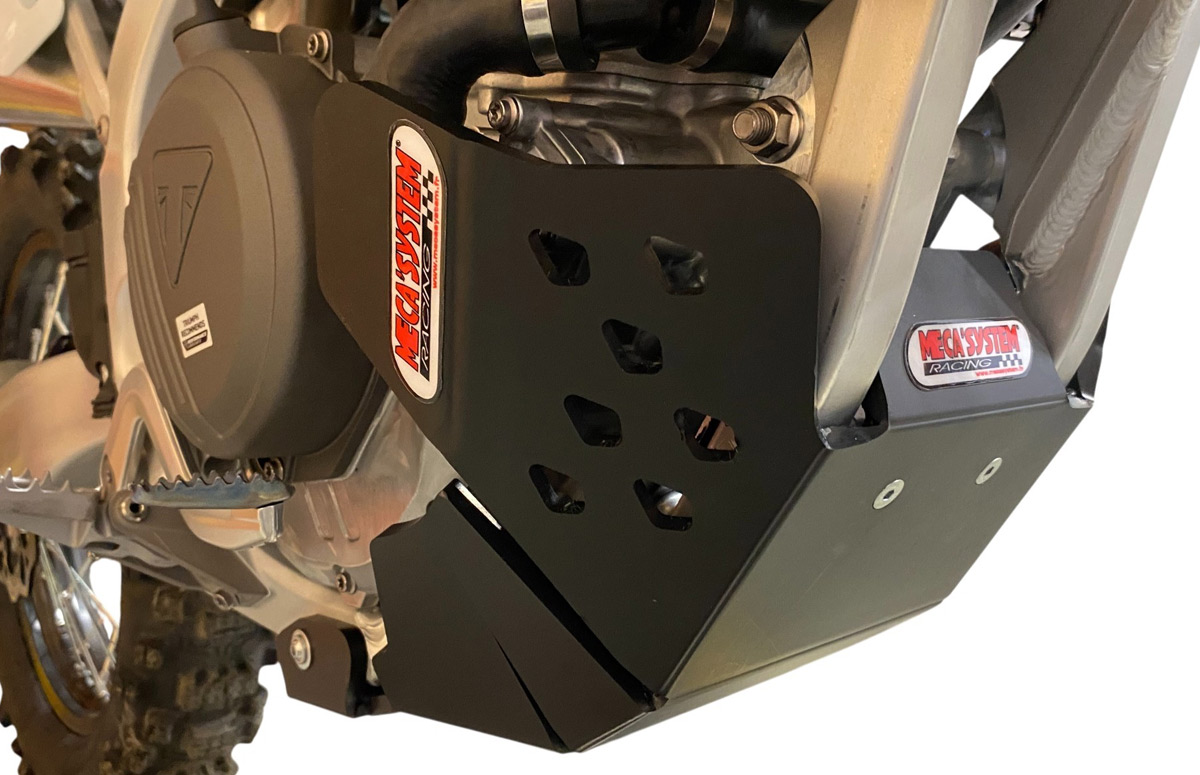
Meca’System hoof – The hyper-solid monobloc hoof
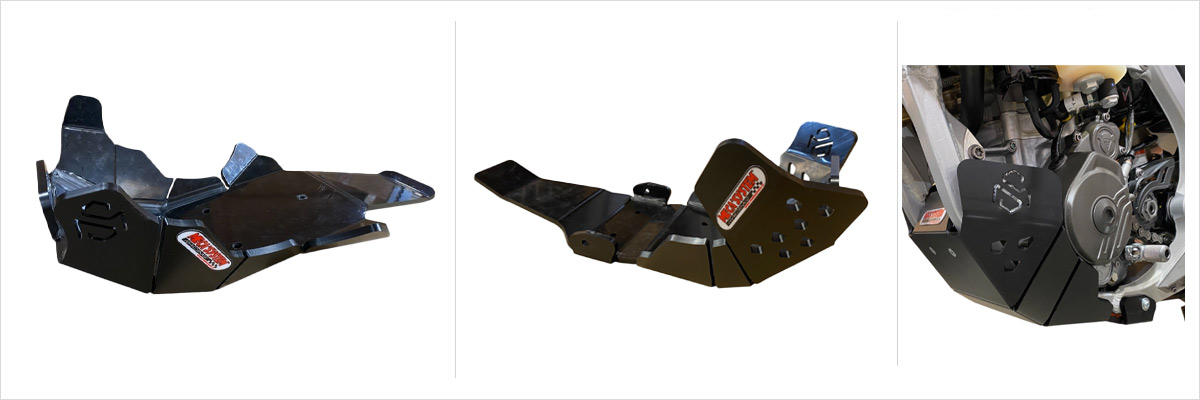
- Material / Thickness: HDPE / 8 mm industrial grade.
- Manufacture: French manufacture with laser cutting and thermal folding of a sheet of HDPE. This one-piece design gives Meca System clogs great overall strength by eliminating the risk of structural breakage.
- Coverage: wide, effectively protecting the bottom of the motor and remounting neatly on the peripherals.
- Biellette: version with extension available according to machine assignments.
User feedback: Meca System has a strong reputation for mechanical robustness. Endurists with a ‘committed hiker’ profile or competitors appreciate the resistance of the whole during repeated impacts against the strains. While versions prior to 2022 could see their lateral “ears” deviate by a few millimetres under the effect of heat (yawning effect), this problem is now perfectly solved. The manufacturer corrected the shot by making slight 2 mm (out of 8 mm thick) cuts in the ear folds and adding an inner weld cord, which permanently stabilises the plastic without the risk of tearing off a piece (it remains monobloc). A small alert, quickly resolved, concerned the Beta 2026 4-Time: following the manufacturer’s change in the design of the original exhaust manifold, the latter passed too close to the plastic and risked melting it. However, Meca System reacted immediately and has already fixed this one-off problem on its templates.
⁇ Also read: Find our complete test of the Meca System XPE Extreme PHD clog
Sabot X-Grip – Austrian twin from AXP

- Material / Thickness: High-density polyethylene (HDPE) / 8 mm high-resilience.
- Manufacture: thermoforming in press and lateral welds carried out directly by AXP in France (technically identical products).
- Coverage: very enveloping, specifically designed to protect master cylinders and low housings.
- Biellette: very rigid XL rear protection tab, designed to optimise gliding over extreme obstacles.
User feedback: This is the exclusive Freenduro info: X-Grip clogs are manufactured by AXP Racing. They are therefore rigorously identical products in terms of design, resistance and behavior. Feedback highlights an exceptional slip coefficient: the motorcycle never “ventuates” on concrete steps or large tree trunks. The biellette protector is considered particularly rigid and does not bend under the weight of the motorcycle. The weak point logically lies in the risk of cracks in the welds in the event of a very large impact (but you have to type really hard).

Sabot CrossPro (DTC series) – The middle ground

- Material / Thickness: DTC (composite technology based on HDPE) / 6 mm.
- Manufacture: CNC machining and calibrated hot bending.
- Coverage: balanced, providing excellent lateral protection without being too prominent.
- Biellette: versions available in short or long version with rear protection of the rods.
User feedback: The CrossPro DTC clog is often described as the “choice of reason”. Pilots praise its feather weight compared to 8mm monsters, its flexibility allows it to return to shape immediately after a shock, and its mounting is considered simple thanks to well-designed fasteners. Some sharp users note, however, that during very violent impacts on the lower tubes of the frame, the thickness of 6 mm flexes slightly more than an 8 mm model, leaving slight superficial marks on the lower cradle of the motorcycle.
Cycra clog (Full Armor range) – US style

- Material / Thickness: High performance injected plastic custom formulated by Cycra / about 4 mm.
- Manufacture: exclusive injection under high pressure with patented fastening system.
- Coverage: very enveloping on the immediate periphery of the ignition and clutch housings.
- Biellette: short profile (KTM) or long profile with extender to protect the rods.
User feedback: Cycra brings American know-how in finishing. Opinions on the US and European fora welcome an exceptional level of adjustment: no play, no parasitic vibration at high speed. Mud drains are wide and excellently designed, limiting overweight during sandy or very greasy enduros. On the other hand, lovers of pure crossing regret the thickness of 4 mm, a little light to cash without bronching the big repetitive shocks on the rocks.
Polisport Sabot (Fortress range) – Quick disassembly

- Material / Thickness: Highly durable injected plastic module / about 4 mm.
- Manufacture: injection molding. Incorporates a patented quick-lock mechanism at the front via a metal lever with floating leg and a moulded rear section directly attached to the frame cross-piece. For purists, it also offers the possibility of a conventional installation fixed by two bolts by piercing the plastic on markers provided for this purpose.
- Coverage: integral and fitted, covering pharma-motor and frame tubes to limit earth accumulation.
- Biellette: very complete model, available in the catalog with or without integrated rod protection.
User feedback: a little thin (4 mm) to withstand perfectly in pure Hard Enduro, the strong point of the Fortress range is its rapid disassembly system by rotating pin or quarter turn. The users were unanimous: to clean your bike after a muddy ride, it is pure happiness, the hoof taking off in 5 seconds. Engine ventilation is also considered above average. The reverse side of the coin shared by users: in clay or sticky mud, the quick-locking mechanism can get heavily clogged, making its initial release sometimes hard without a prior high-pressure cleaner jet. On the other hand, the integrated protection of the underfoot brackets is particularly appreciated.

Rtech Sabot – The smart and scalable injected challenger

- Material / Thickness: Injected technopolymer of exclusive formulation / about 4 mm.
- Manufacture: monobloc injection in high press, ensuring the complete absence of welded breakpoints.
- Coverage: Ultra-enveloping! Visual feedback confirms very high side protections housing the water pump and crankcases (as on Brad Freeman's official Beta).
- Biellette: unique modular architecture. Originally sold short, the clog incorporates two threaded metal inserts and moulded detrompeurs in the mass to screw in an optional rod extension.
User feedback: Rtech surprises practitioners with this ultra-finished piece. Buyers underline the quality of the system of moulded hooks at the front that clip onto the frame, making the initial placement childish. The rear modularity is acclaimed by riders with several motorcycles or riding in KTM PDS (who keep the hoof short without dragging an unnecessary tongue). The flexibility of the technopolymer avoids breaking, although the underside scratches aesthetically quite quickly under violent impacts.

Comparative table of plastic motor hooves
To help you visualise the offer at a glance, here is our complete summary of the forces involved:
Assembly and maintenance: the tips of writing’
Having the best hoof in the world is not enough; it must still be properly installed and maintained to avoid unpleasant surprises when disassembly takes place. Here are three tips from old breakers:
💧 The moisture trap (dismount to dry)
This is the classic error. We wash the bike, we brush the plastics, but we leave the hoof in place. Water and moisture remain sandwiched between the plastic and the frame for weeks. In the long run, this attacks the paint, creates corrosion (rust on the steel frames, white oxidation on the alu) and can seriously weaken your cradle. Our advice: Remove the hoof at least one in two washes to let the frame breathe and dry.
🧽 The anti-mud clog foam
During winter outings, the space between the engine and the hoof is filled with sticky mud. Result: you quickly embark 2 to 3 kg of useless ballast, and the engine cools less well. The solution? Slide a block of clog foam (a very aerated special honeycomb foam) which prevents the mud from settling in without blocking the air or retaining the water.
🛡 Protecting the frame from friction and vibration
Even in plastic, a clog moves imperceptibly with the vibrations of the engine. If the plastic rubs directly on the metal in the frame, it will act like sandpaper and eat the paint to the bare metal. The parade: Glue strips of dense fine foam, neoprene or rubber (thick chatterton type) on the frame tubes at the points of contact with the hoof. This removes annoying resonance noises and protects your frame. Please note: some high-end brands deliver these protective strips directly into the mounting kit.
The Freenduro Editorial Board
- For the Hard Enduro franchiser: Proponents of massive "blinding" will opt for HDPE in 8 mm (AXP Xtrem or X-Grip who share the same French manufacture, or Meca System) to take repeated shocks and slide on rocks. If you prefer a fluid, seamless, one-piece solution injected, the Rtech Enveloping or the very practical Polisport Fortress are formidable modular alternatives. Finally, for an ultra-rigid plant profile that specifically protects the footstool supports from mud and pebbles, theAcerbis Factory Nylon/Alu remains the choice validated by the pros.
- For the classic/League driver: the Rtech modular, the Polisport Fortress, on AXP Standard 6 mm, on CrossPro in 6 mm or Cycra Full Armor offer the perfect compromise between weight gain, effective crankcase protection and aerodynamics.
- For the hiker / small budget: a standard injected plastic clog like the Polisport Fortress or lAcerbis Classic will do the job perfectly to protect the lower engine from projections and strains without unnecessarily burdening the bill.






Comments
Leave a comment