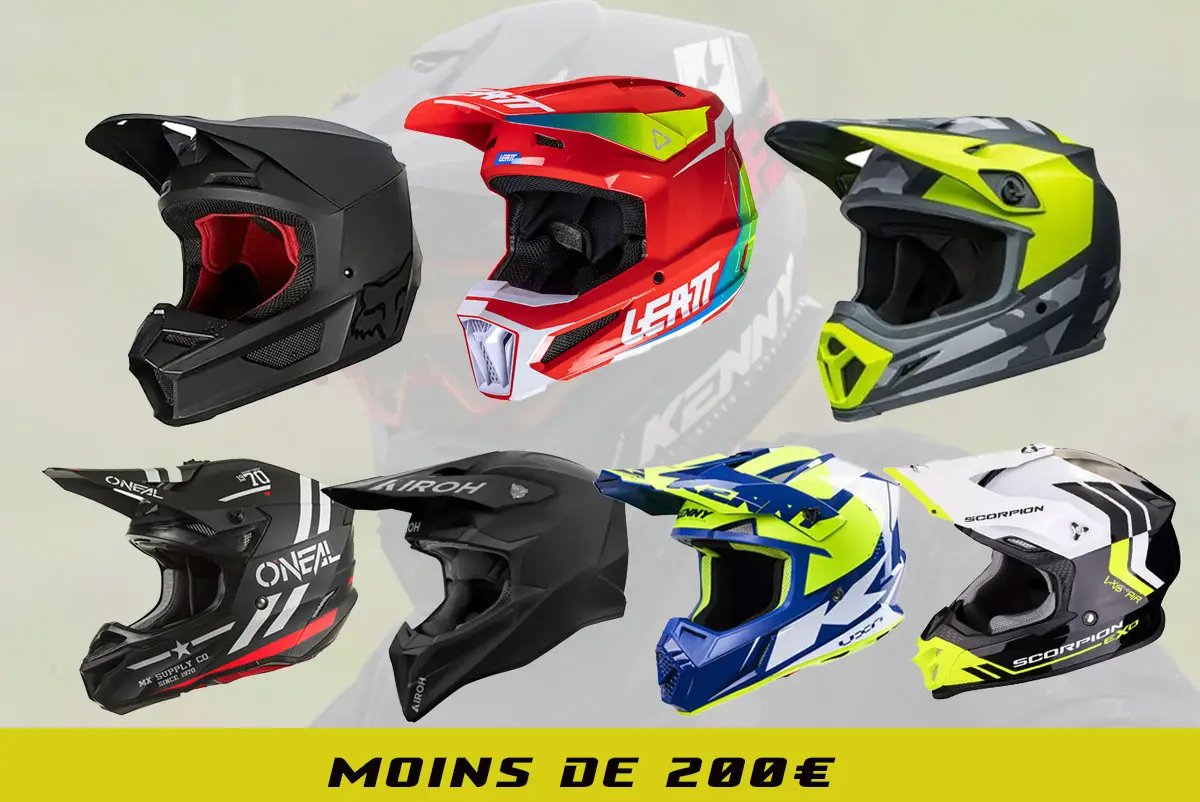
Which helmet for less than €200 to choose for enduro or motocross?
To practice motocross or enduro safely, the choice of helmet is the first critical step. In 2025, the democratisation of rotary protection technologies (MIPS, Turbine) gave amateur pilots access to a level of safety once reserved for the elite. We analyzed and selected the 7 best off-road helmets for less than 200 € ECE 22.06 approved, without compromising on cap density or ventilation.
Top 3 best motocross and enduro helmets for less than 200 €
- Leatt 2.5 Headset : The tech champion. With its inserts 360° Turbine and a lightweight polymer shell, it offers the best protection/price ratio in the category.
- Fox V1 Headset : The American standard. Now in ECE 22.06 with standard MIPS, it is the choice of versatility and style, despite a slightly larger hull volume.
- Bell MX-9 MIPS Headset : The indestructible. Massive ventilation and a 5-year guarantee unique on the market, ideal for hard-core riders.
Detailed classification and technical analysis
Our selection methodology:
This ranking is not based solely on price. We have prioritised:
1. Rotational energy management: Mandatory presence of MIPS or equivalent (Turbine).
2. EPS density: The ability of the internal calotin to absorb shocks at high and low speeds (new requirement ECE 22.06).
3. Actual breakdown: Not only the number of holes, but the depth of the internal channels for slow enduro air extraction.
Important reminder: In competition (FFM/UFOLEP), ECE 22.06 approval is gradually becoming the only mandatory standard. See FFM Regulation
All helmets below comply with this standard 22.06.
1. Leatt 2.5 headphones: Surgical protection
The Leatt 2.5 is an engineering feat: it makes high-end security accessible. Its injected polymer composite shell houses the technology 360° Turbine : flexible discs that harden at impact but allow low-speed rotation, reducing up to 30% concussions and 40% rotational acceleration of the brain.
- Estimated weight: 1270g (+/- 50g)
- The + Expert: Unlike many entry-level helmets, the 2.5 visor is designed to detach immediately in the event of a crash so as not to shoot the cervicals.
2. Fox V1 headphones: The evolution of the Best-Seller
Fox has completely overhauled its entry-level. The V1 incorporates the MIPS (Multi-directional Impact Protection System) which insulates the head of the hull via a low-friction layer. Ventilation is provided by 9 air intakes and 4 extractors, which is excellent for venting heat at low enduro speeds.
- Estimated weight: 1350g (Size M)
- The + Expert: The ejectable visor system has been replaced by more reliable lateral fusible screws, which break sharply in the event of a shock to avoid the leverage effect on the cervicals.
3. Bell MX-9 MIPS headphones: American Reliability
The Bell MX-9 is a “mule” in the correct sense of the word: robust and durable. Its ABS polycarbonate shell is massive but reassuring. It is one of the few helmets in this range to offer 3 sizes of external caps, avoiding the ‘bulb head’ effect for small sizes.
- Estimated weight: 1500g (A little heavy, but very balanced)
- The + Expert: Its manufacturer's warranty of 5 years is a guarantee of quality of manufacture (molasses, paints) rare under 200 €.

4. O’Neal 5SRS headphones: The Technical Challenger
5SRS is not just a plastic helmet. It uses an ABS construction with oversized ventilation channels. The Coolmax® interior offers better sweat evacuation than basic synthetic fabrics.
- The + Expert: The Double-D buckle closure is easy to handle even with gloves, an indispensable safety standard for jugular clamping.
5. Airoh WRAAP helmet: The feather weight
True to the Airoh DNA, WRAAP is all about lightness. Its HRT (High Resistant Thermoplastic) shell reduces cervical fatigue during long enduro outings. Be careful though, it often size a little small at the cheeks.
- Estimated weight: ~1280g
- The + Expert: Its field of vision is particularly wide, accepting modern “Wide Vision” masks (Oakley Airbrake or Scott Prospect type) without discomfort.
6. Scorpion VX-16 Evo headset: Tailor-made
The only helmet on the market equipped with the system AirFit®. A pump located in the chin strap allows to inflate the cheek foams for a personalized support. This is ideal if you are between two sizes or to compensate for the compaction of the foams after a season.
- The + Expert: The visor extension provided in the box is a real bonus for rolling in mud or shaving sun.
7. Kenny Track: The French alternative
The Kenny Track is a pragmatic helmet. It uses a classic but effective polycarbonate shell. If it does not incorporate patented MIPS-type rotational technology, it compensates with a very aggressive price and a fully removable interior that is highly resistant to frequent washing.
- The + Expert: The cut-out of the chin chin leaves a good space to breathe, which is crucial in enduro specials when the cardio goes up.
Expert advice: Choosing well beyond the size
 Beyond ECE 22.06 (non-negotiable), here are three technical points to be checked before purchase:
- The “Test of cheeks”: A new helmet should tighten your cheeks, almost making you bite the inside of your mouth. Foams will settle from 15 to 20% after 10 hours of driving. If you are “comfortable” from the moment of purchase, the helmet will be too big in a month.
- Mask compatibility (Google Fit): The facial opening (Eye port) varies by brand. The Bell and Fox have wide openings, ideal for large modern masks. The Airoh is more compact.
- Maintenance of the calotin: Prefer removable interiors with clip system (pressure) rather than velcro, which age better at machine washes (30°C max, without softening).
Technical decryption: ECE 22.06, MIPS and Turbine
Why is ECE 22.06 a game changer?
Full entry into force in January 2024, ECE 22.06 is not just an administrative buffer. Finally, it introduces Oblique impact tests (rotation), a necessity validated by the researchers of the Certimoov Laboratory (University of Strasbourg) and the famous Virginia Tech Helmet Lab.
Specifically, the 22.06 helmets now incorporate more complex caps. For example, technology 360° Turbine Leatt claims, according to their laboratory tests, a reduction up to 30% energy at concussion level.
Advice: Flee the end of stock in ECE 22.05, even sold out. The difference in protection is real.
MIPS vs Turbine 360°: The match
These two technologies serve the same purpose: reduce the rotational acceleration of the brain in the cranial box during a biased impact.
- MIPS (On Fox, Bell): A movable yellow plastic sheet between the calotin and the comfort foam. It offers 10 to 15mm of movement. Very effective, but sometimes slightly reduces ventilation.

- 360° Turbine (Sur Leatt): Blue gel pads (Armourgel). They absorb linear AND rotational energy. Advantage: they do not block airflow and are more comfortable against the skull.

By choosing from these 7 22.06 models, you drive with the current safety standards. The “best” will be the one that best fits the shape of your skull.




Comments
Leave a comment