Buying Guide and Comparative Guides Renthal

Twinwall VS Fatbar
Both the Fatbar and Twinwall handlebars of the Renthal brand are high-end and very strong handlebars designed for cross-country and enduro motorcycles. Although they have similarities, there are also key differences between the two models.

The main difference between the two handlebars is their construction. The handlebars Fatbar is without a backup bar central and is made from an aluminium alloy 7050-T6, while the handlebars Twinwall with Reinforcement Bar is made from a stwo-layer aluminium stitching different (7010 T73 and 7010 T6) to offer greater impact resistance.
In terms of shape, the Fatbar handlebar has a 7-degree rearward curve and a 40 mm elevation, while the Twinwall handlebar has a 5-degree rearward curve and a 32 mm elevation. This means that the Twinwall handlebar is slightly flatter than the Fatbar and offers a slightly different driving position.
Finally, the Twinwall handlebar is slightly more expensive than the Fatbar due to its more complex construction and thicker diameter.
The Twinwall model with its 2 layers is a little more resistant to shocks than the Fatbar. But a contrario, it is more rigid and less comfortable of the Farbar. The Fatbar model due to the absence of a reinforcement bar has a certain flexibility and a capacity to better absorb small shocks transmitted by the fork (which can be interesting in enduro).
The diameter of the two handlebars at the fixing of the fixing bridges is 28.6 mm.
How to choose the height of your handlebar according to its size?
It is generally accepted that the choice of handlebar height depends heavily on the size of the driver, so to simplify the choice, three possibilities can be considered:
- Driver of less than 1.70 m: low handlebars
- Pilot between 1.70 m and 1.78 m: middle handlebars
- More than 1.78 m: high handlebars
The size of the handlebar is of course an important parameter that will condition your comfort on the bike, but it is not the only parameter to take this into account. It will also be necessary to choose your handlebar according to the size of your handlebar bridges (and raised for those who use them) but also according to the shape of the hanger that suits you best.
For example: David Knight who is a large pilot with a preference for the Twinwall 999 which is the lowest of the Twinwalls and does not use the 922 which would a priori suit him better. But after trying several Renthals, Knight says he feels better about attacking with the 999. Josep Garcia, who is a small pilot, also uses the Twinwall 999 (and he leans it towards him to lower the height one more) which corresponds perfectly to his size. So it's up to you to get an idea by testing various handlebars, but respecting the size recommendations, you should not be very far from the handlebars that will suit you well.
Our selection of 6 models of Renthal handlebars
To simplify the task, we have therefore pre-selected 3 references for the Fatbar (without reinforcement bar) and 3 references for the Twinwall (with reinforcement bar) depending on the size of the driver, but also on our experience, by selecting models (such as the 999 for example) acclaimed and used by many drivers.
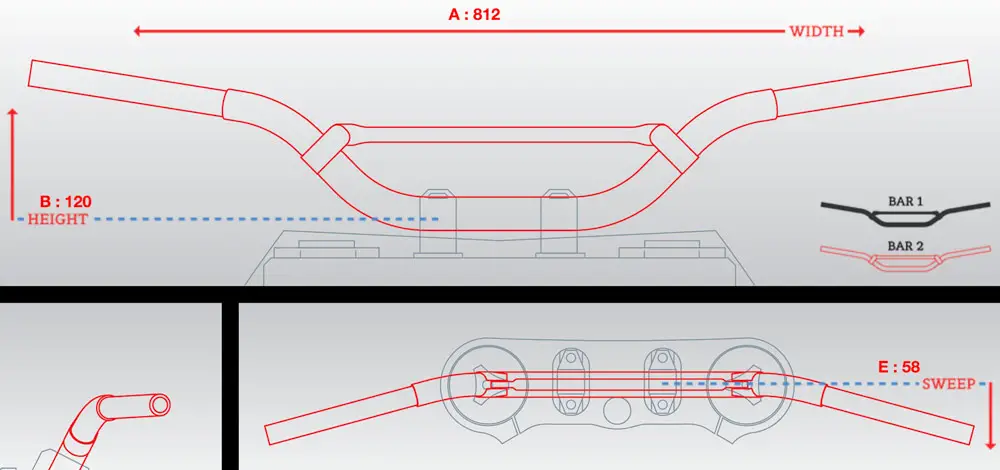
To be able to compare, we have for each of the models indicated the different dimensions (in mm). The height is indicated by measure B.
Renthal Fatbar handlebars (without bar)
At Renthal the barless handlebar model is the Fatbar. A little more flexible than the Twinwall, it often has the preference of the endurists.
♦ Low Handlebar
Renthal Fatbar 821 (Mc Grath)

♦ Average guide
Renthal Fatbar 603 (Reed/Windham)

♦ High Handlebar
Renthal Fatbar 609 (RC Hight)

Renthal Twinwall Handlebar (with Reinforcement Bar)
A little stiffer than barless handlebars, the Renthal Twinwall handlebars are known to offer exemplary strength and to be virtually indestructible. The Twinwall also has a higher fare of around €50-60 than the Fatbar.
♦ Low handlebars
Renthal Twinwall 999 (Mc Grath)
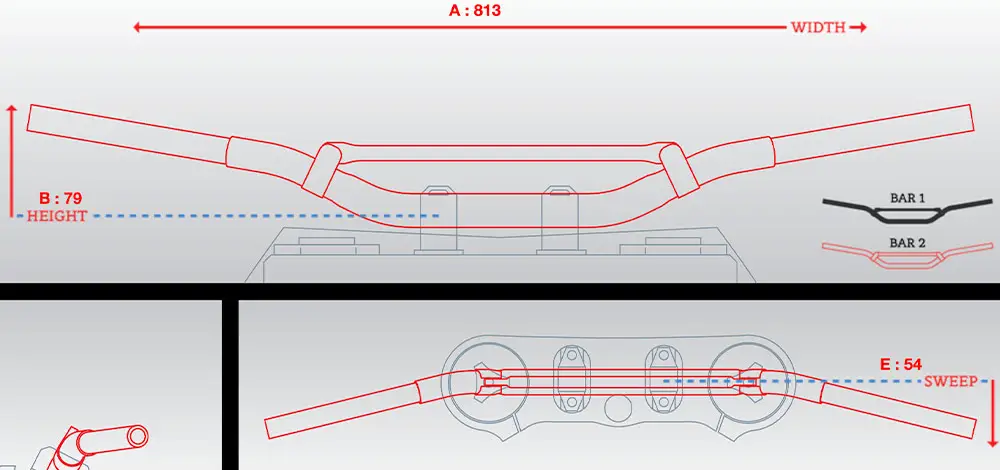
♦ Average guide
Twinwall 998 (Reed/Windham)

♦ High Handlebar
Twinwall 922 (RC hight)
The history of the Renthal brand
Renthal is a British company founded in 1969 by Henry Rosenthal and Andrew Renshaw. Originally, the company only produced handlebars for Motocross motorcycles. The company quickly distinguished itself from the competition by the quality and strength of its handlebars, which were quickly acclaimed by the champions of MX, SX and enduro (with Jeremy Mcgrath, Ricky Carmichael, David Knight, Ryan Villopoto, Ivan Cervantes, Toni bou etc.)
Over the years Renthal has developed numerous innovations in the field of handlebars and motorcycle parts, including the use of state-of-the-art materials such as 7075 T6 aluminium and titanium. The brand has also developed innovative manufacturing processes, such as the T6 heat treatment, which strengthens aluminium handlebars while reducing their weight.
Today, Renthal offers a wide range of products for motorsports, particularly handlebars, but also handlebars, crowns, pinions and chains. The brand is present worldwide, with distributors in many countries, and continues to innovate to offer ever more efficient products adapted to the needs of professional and amateur pilots.







Comments
On 16 July 2023 at 5h46, Laurent said:
Hello, I have a Jimmy Button model but I can not estimate the center bar. Is there a trick I can't find? Can this be done (is what the handlebar remains "safe" without this bar) Thank you
On 16 July 2023 at 18:35, Freenduro said:
The screws are mounted with thread brake, so it is necessary to force a little (put a blow of thermal stripper on the screws before it will help to unscrew more easily )
Leave a comment